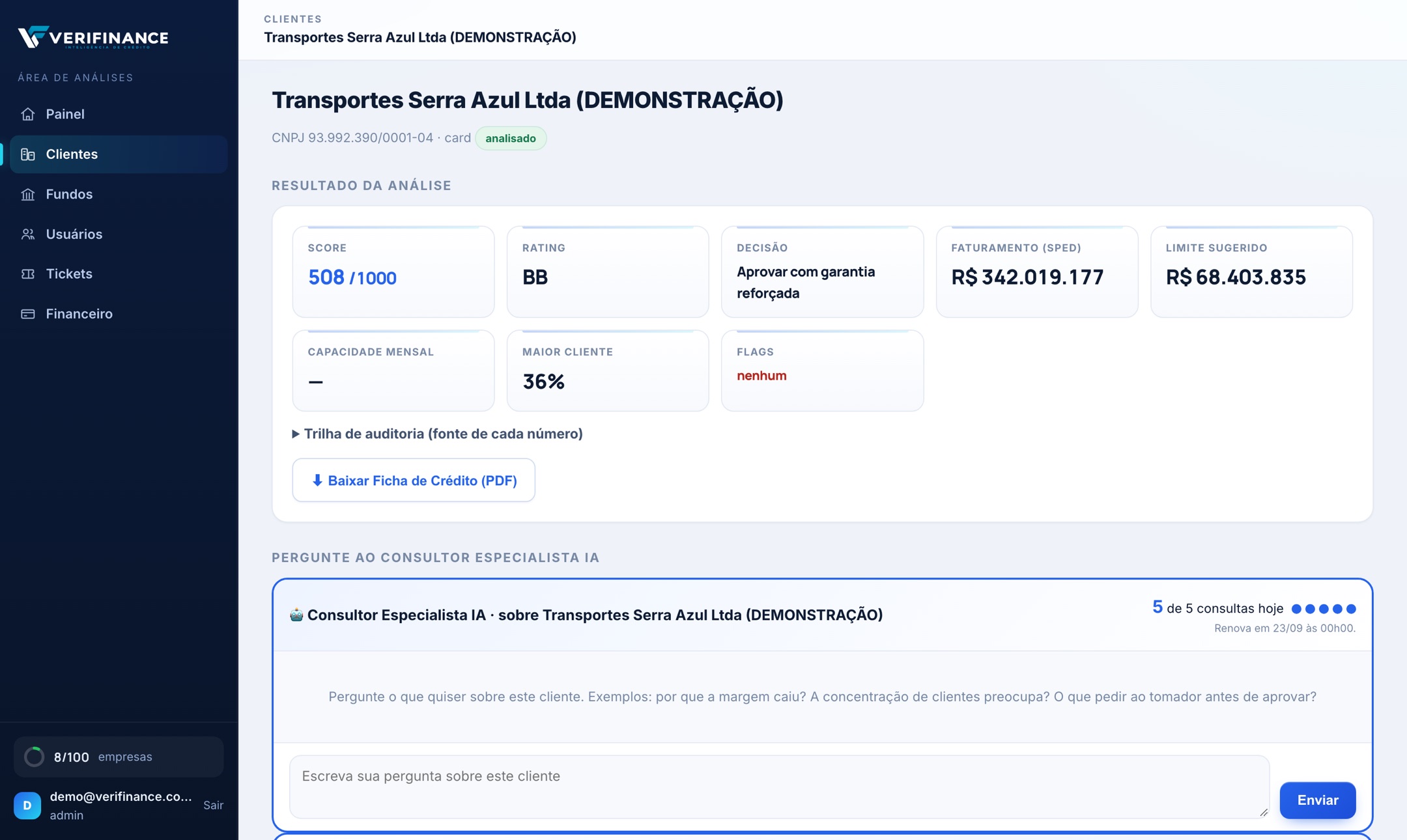
Real screen of the system. Company, figures and tax ID are fictitious, created for demonstration.
Credit analysis built from the accounting and tax records a company filed with the Federal Revenue Service: data audited by the tax authority, not the balance sheet the borrower prepared for the bank.
Real screen of the system. Company, figures and tax ID are fictitious, created for demonstration.
The balance sheet is a document written for the lender. SPED is a filing the company was required to make under criminal liability.
Under-declaring is a tax crime. A company filing with the tax authority has no incentive to flatter itself: declaring more means paying more tax.
The company is checked against what third parties declared about it and what it actually paid. Fraud does not survive the cross-check.
With the power of attorney active, the analysis is rebuilt every month, automatically. You see how the client is now, not only on approval day.
To fool the analysis, a company would need to collude, at once, with the tax authority, every customer and every supplier.
Revenue × DF-e, DIRF and EFD-Reinf × DARF. Any divergence becomes a flag in the score.
Under the new system, a buyer's IBS and CBS credit depends on the supplier actually paying the tax. Weak tax management stops being only the accountant's problem and becomes a commercial one. For you, it becomes credit risk.
The analysis is rebuilt every month, automatically, for as long as the power of attorney lasts.
Falling revenue, late payments, active debt, shifts in concentration: flagged at any time, not at quarter end.
We monitor the tax compliance of your securitizer's or FIDC's clients, because from 2027 one determines the other.
Explained score and rating, revenue and concentration, income statement and balance sheet from the ECD, suggested guarantees, tax collateral and monthly snapshots. On the same card, a folder holds the articles of association, property deeds, appraisals, receivables assignments and whatever else the committee asks for.
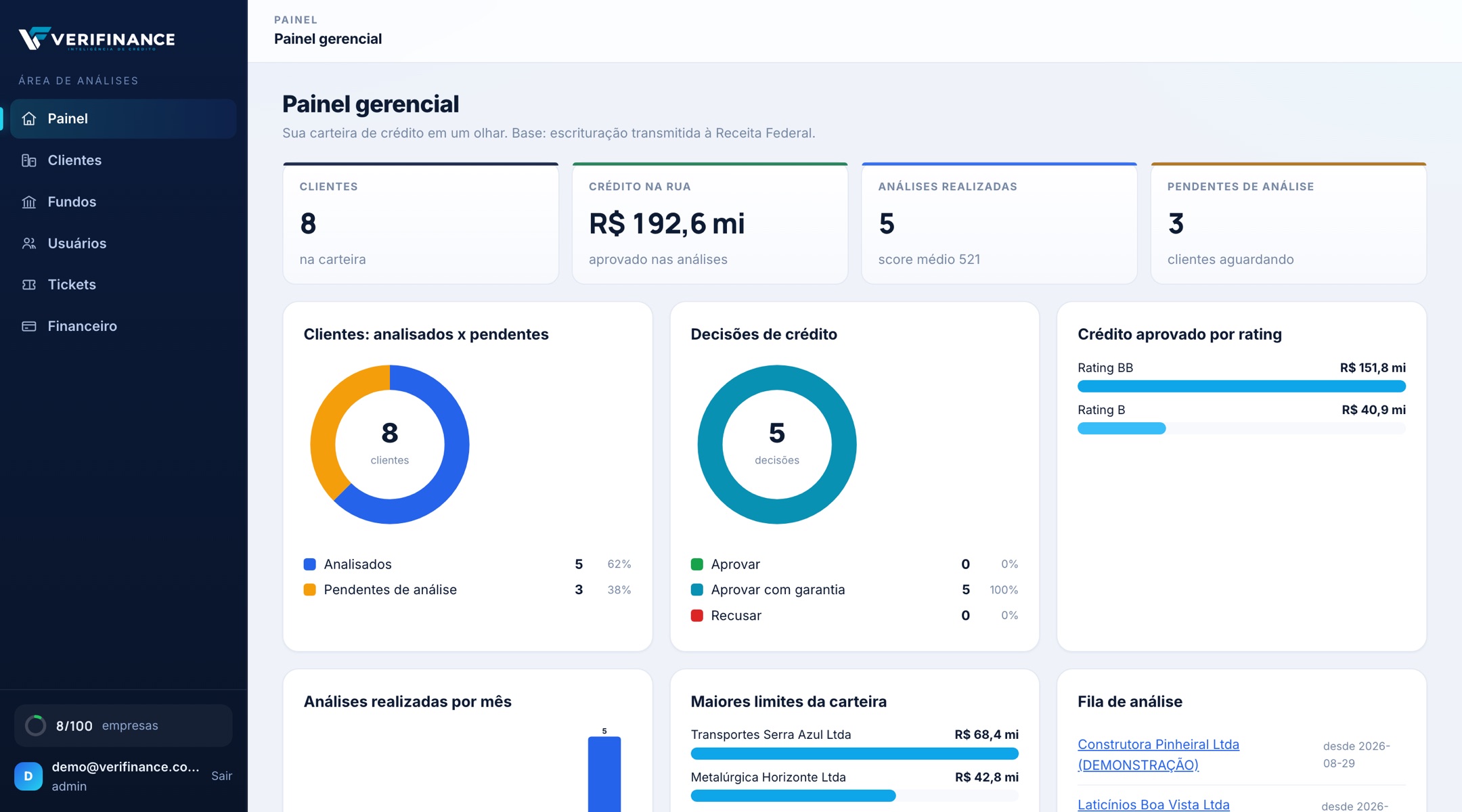
Dashboard: how many clients, how much credit outstanding, how many analyses done and who is in the queue.
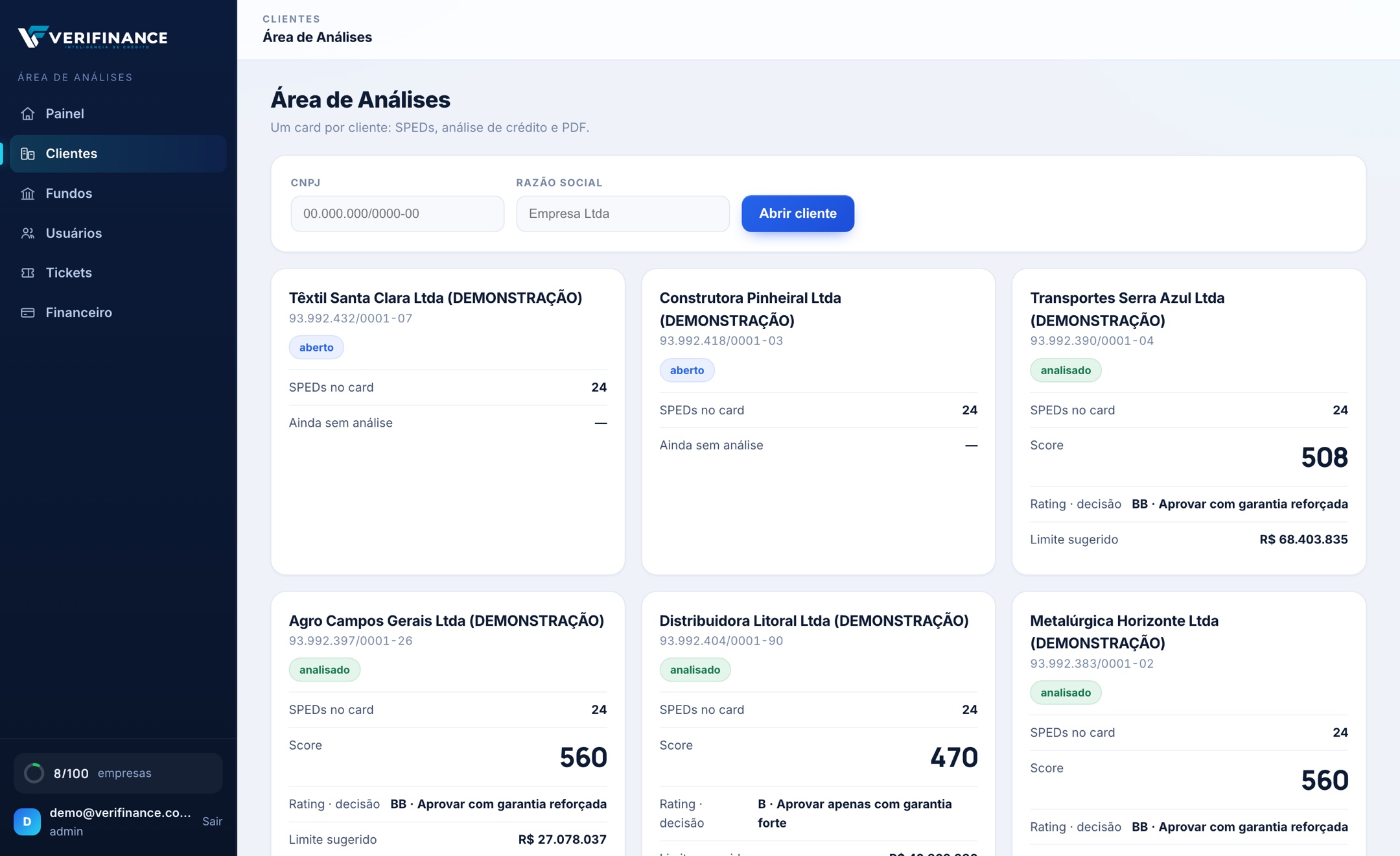
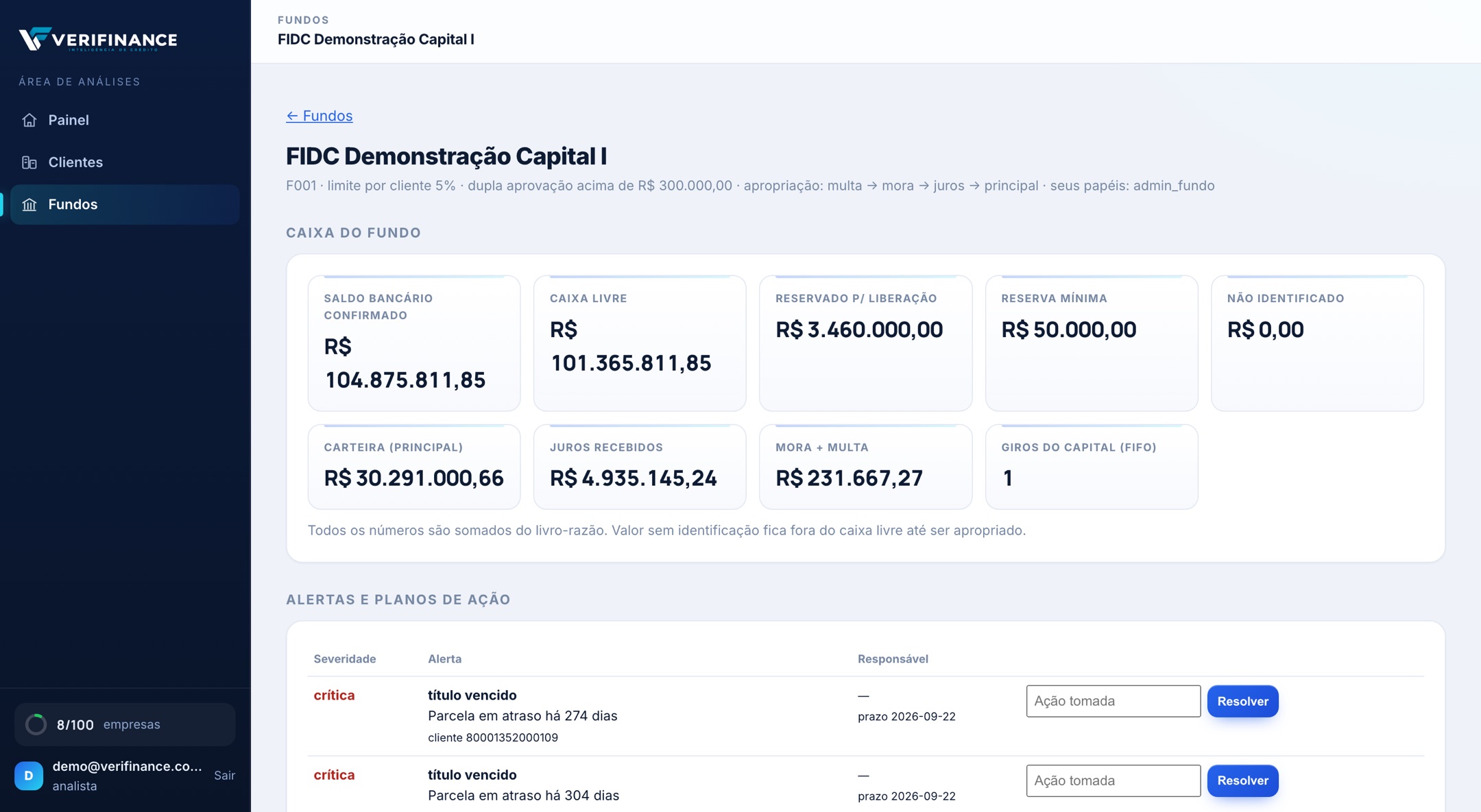
Companies, figures and tax IDs on these screens are fictitious, created for demonstration only.
Trained on our team's tax, financial and legal knowledge, the consultant sees the whole analysis: SPED, ECD, indicators and the audit trail of every figure.
Ask why margin fell, whether customer concentration is a concern or what to request from the borrower before approving. The answer comes with its source, pointing to the exact line the figure came from.
The borrower's tax asset, managed by Verifisco, is turned into a financial asset and held in custody by the securitizer. With each confirmed contribution, collateral rises and unlocks more credit.
Liquid collateral means a lower rate for the client and more limit for the fund. Everything is tracked on the dashboard, with conversion period and contribution schedule.
Collateral does not form at once: each month the company stops paying the tax slip, Verifisco offsets and holds it, and confirmed collateral rises. Demonstration figures.
The power of attorney is granted to the system. Collection, reading and analysis are automatic end to end: no one at Verifinance and no one at your company needs to handle your client's records.
No documents requested from the borrower. No spreadsheets. No human involvement in collection.
Your client grants the power of attorney to the system, not to a person. Within minutes, collection becomes automatic through Receita BX.
SPED Fiscal, Contribuições, ECD, ECF, DCTFWeb and DARF from recent years, read and reconciled by the engine.
Seven pillars: repayment capacity, revenue, profitability, balance sheet, tax health, anti-fraud and registry. Suggested limit and term.
Full PDF with income statement, balance sheet, concentration, guarantees, opinion and audit trail. Monthly snapshot while the power of attorney lasts.
No cost per analysis. Anyone joining Lot 1 keeps the price for as long as the subscription lasts, even after the lot closes.
Following lots: R$ 1,189 per month (Lot 2) and R$ 1,789 per month (Lot 3, reference price).
No sign-up, no scheduling, no one calling you.
 Company presentation
We confirm your email before any registration. You get the link, click it and continue to plan, company details, contract and payment. No calls, no salesperson.
Prefer to talk first? Write to contato@verifinance.com.br.
We use measurement and marketing cookies to understand where visits come from and improve our communication. Your choice: we only enable them if you accept. See our Privacy Policy.
Sign in to your Verifinance platform.